Discover the top automatic fish feeder solutions available on Amazon to keep your aquarium residents well-fed while you’re away. These devices vary in capacity, power options, and feeding schedules, but all share the goal of delivering precise portions on a timer. Below are five highly relevant picks with standout features to help you choose the right model for your tank size, fish type, and daily routine.
| Product | Brand | Capacity | Power | Key Feature |
|---|---|---|---|---|
| Aoyar Automatic Fish Feeder Dispenser | Aoyar | 200 ml | Battery | Three feeding modes with 8/12/24 hour rotations |
| FREESEA Automatic Fish Feeder | FREESEA | — | Battery | 8h/12h/24h schedules with manual feeding option |
| Petbank Automatic Fish Feeder | Petbank | 16 grids (approx. 30 meals) | USB rechargeable | Moisture-resistant, two installation methods |
| FISHNOSH Automatic Fish Feeder (Thermometer) | FISHNOSH | — | Battery | Digital thermometer, up to 9 portions daily |
| DXOPHIEX Automatic Fish Feeder | DXOPHIEX | — | Battery/USB | Automatic 8/12/24 hour modes with USB power option |
Aoyar Automatic Fish Feeder Dispenser

The Aoyar feeder offers a 200 ml capacity with adjustable feeding volume to prevent overfeeding. It supports three fixed intervals—8, 12, or 24 hours—and a manual feeding mode for unscheduled needs. Its moisture-proof lid helps keep flakes and pellets dry during storage, reducing clumping and spoilage. The device is designed for small to mid-sized tanks and can operate while you travel or work long hours.
FREESEA Automatic Fish Feeder for Aquarium
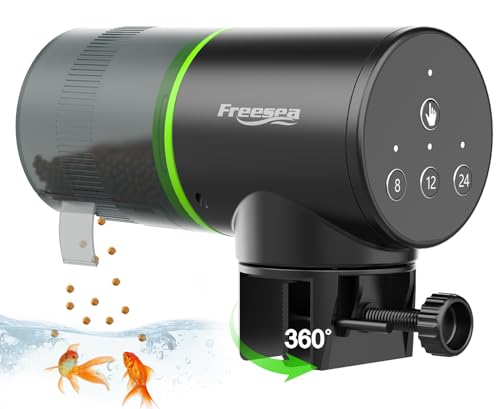
FREESEA provides both manual and automatic feeding with 8h, 12h, and 24h options. It uses a 360° rotation to deliver food and allows you to control portions by top-opening adjustment, accommodating the number and size of fish. Its moisture-resistant design aims to keep various foods fresh, including granules, strips, and flakes, and is suitable for small tanks, bettas, and turtles.
Petbank Automatic Fish Feeder for Aquarium

Petbank’s feeder emphasizes precise portioning with 16 feeding grids, enabling up to about 15 meals with controlled weights per meal. It offers two mounting options—adjustable clamp base or suction cup—so it fits a wide range of tanks. A fully sealed moisture-resistant design prevents moisture from entering the feeding outlet, helping maintain the quality of pellets, powders, and small strips. Not recommended for shrimps or flakes.
FISHNOSH Automatic Fish Feeder with Digital Thermometer
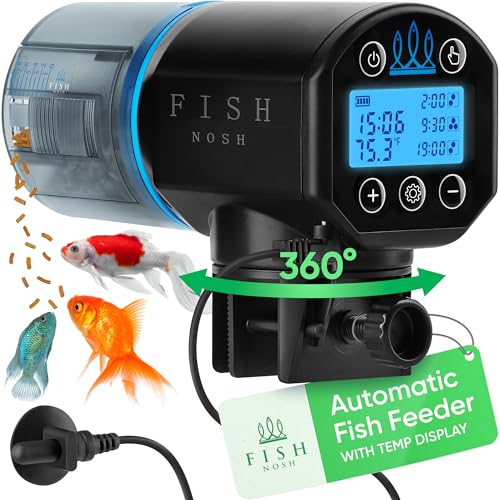
This model pairs automatic feeding with a built-in thermometer, delivering up to nine portions daily across a flexible schedule. It is designed for compatibility with small to large aquariums and acts as a vacation feeder. The thermometer alert helps monitor water conditions, adding a health-check dimension to routine feeding, though the unit emphasizes simple, straightforward operation rather than complex programming.
DXOPHIEX Automatic Fish Feeder

DXOPHIEX offers automatic feeding with 8/12/24 hour presets and a USB power option for continuous operation. It can be mounted on tank edges or hooded tanks, giving flexible installation. The design supports manual feeding in addition to scheduled feedings, making it suitable for varied daily routines and power-outage contingencies when used with USB and battery power in tandem.
Buying Guide: Key Purchase Considerations
- Tank compatibility: Consider capacity relative to your tank size and fish quantity. Larger tanks may benefit from feeders with higher volume or multiple feedings per day.
- Feeding schedule needs: Look for models with multiple preset intervals (8/12/24 hours) and flexible daily limits. For vacation use, consistent timing helps maintain routine.
- Power options: Battery-operated units offer portability and resilience during outages; USB-powered units provide stable operation when plugged in. Some models support both for redundancy.
- Moisture protection: Moisture-proof lids or fully sealed compartments prevent food from clumping, preserving freshness and reducing waste.
- Feeding precision: Check the adjustment mechanism for portion control. More grids or measurable increments generally allow better control over feeding amounts.
- Installation versatility: Two mounting methods (clamp base vs. suction cup) expand compatibility with different tank types and hood designs.
- Food compatibility: Ensure the feeder accommodates your typical fish foods (flakes, pellets, powders, strips) safely without clogging.
- User-friendliness: Look for intuitive controls and clear indicators. Clear instruction manuals help minimize setup time and errors.
- Maintenance: Refill and cleaning should be straightforward; moisture resistance reduces maintenance frequency and keeps food dry.
- Durability and warranty: Check build quality and warranty terms, especially for long-term vacation use or daily reliability.